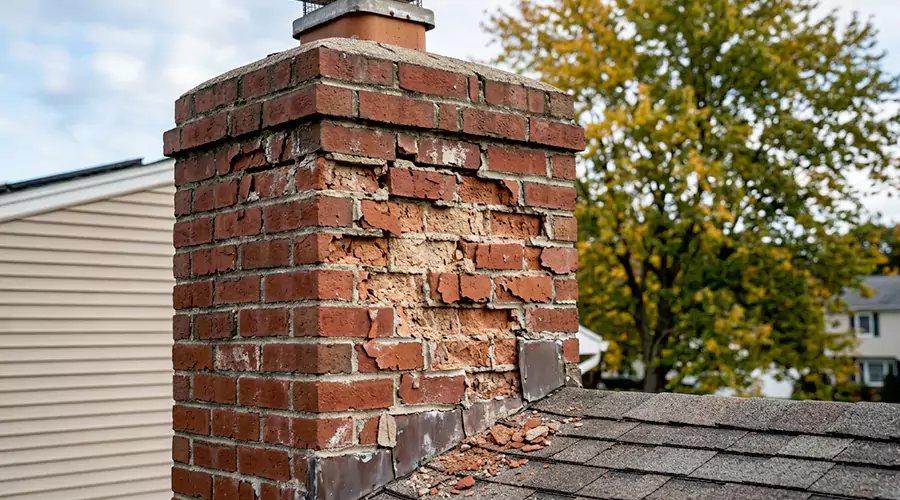
What Causes Spalling Bricks on a Chimney
Chimney spalling happens when moisture damages brick faces over time. Discover the causes, repair options, and prevention steps to protect your chimney.




Based on 500+ Reviews

Proudly American
Owned & Operated

Spalling bricks on a chimney usually develop when masonry absorbs water and weather exposure breaks the brick face apart. In cold climates, trapped moisture can freeze and expand inside porous brick. The surface then flakes or chips. In warmer areas, long-term saturation and salt movement can cause similar deterioration.
Chimney spalling is more than a cosmetic problem. Once the outer face breaks away, the softer material inside absorbs water faster. Damage can then spread into nearby bricks and mortar. Current 2026 estimates place spalling brick repair around $1,000 to $3,500 depending on the amount of masonry affected.
Several conditions can feed that moisture problem: Chimney bricks start spalling when moisture enters the masonry faster than it can dry. The problem becomes worse when water reaches bricks through a cracked crown or damaged mortar. Freeze and thaw cycles can then create enough internal pressure to break the hardened surface away.
A past repair can contribute to future damage when the materials prevent normal moisture movement. Historic masonry guidance notes that mortar should generally remain softer than the brick so moisture and salts can move through the joints rather than damage the masonry units.
Spalling often starts with shallow surface flakes before deeper sections begin breaking loose. Each lost face exposes more porous material. That material takes in water faster and can accelerate later damage. Early correction usually requires less masonry work than delayed repair.
| Damage Stage | What You May See | Likely Repair Direction |
|---|---|---|
| Early | Small flakes or rough faces | Find the moisture source |
| Developing | Chipped corners or cavities | Replace isolated damaged bricks |
| Moderate | Several deteriorated bricks | Repair masonry and water entry |
| Advanced | Deep brick loss | Rebuild part of the chimney |
| Severe | Movement or widespread failure | Structural evaluation |
A 2026 national cost guide places spalling brick repair at about $1,000 to $3,500. Partial chimney rebuilding may cost about $1,000 to $5,000 while full replacement can cost much more.
Spalling is usually visible before a chimney becomes unstable. The most useful clues are changes in the brick surface and pieces of masonry collecting below the chimney. Check from the ground after winter or after long periods of wet weather. Look for these warning signs:
White staining can show that moisture and soluble salts are moving through masonry. It does not prove a brick will spall, but it gives you a reason to inspect the area closely.
You can perform a safe ground-level check without climbing onto the roof. Use binoculars or a camera with zoom to photograph the chimney from several sides. Compare the images after heavy rain or after a cold season to see whether the surface loss is spreading. Check the following:
Do not pry at loose masonry from a ladder. Falling fragments and unstable brick can make roof-level inspection unsafe.
The correct way to fix spalling bricks starts by stopping the source of moisture. Damaged bricks are then replaced when their faces or cores have deteriorated too far. Repairing visible brick without correcting the crown or mortar can allow the same problem to return.
A typical chimney spalling repair may involve removing damaged bricks and installing matching replacements. Deteriorated joints may require chimney repointing. Crown cracks or flashing defects must also be corrected when they are feeding water into the stack.
Professional evaluation is appropriate when several bricks are loose, deep sections are missing, or damage reaches multiple courses. Roof access also creates fall risk. A chimney or mason specialist can determine whether isolated brick replacement is enough or whether part of the stack needs rebuilding.
Arrange an inspection when:
The chimney spalling repair cost depends heavily on how far deterioration has spread. A few damaged bricks require a different repair than a weakened upper stack.
Prevention starts with controlling water before it saturates the brick. Inspect the crown and visible mortar at least once each year. Check again after severe weather. Correcting a small water-entry point can protect sound masonry before the brick faces begin to fail.
Useful maintenance steps include:
Do not treat damaged brick until you know why it stayed wet.
Spalling bricks usually point to a moisture problem rather than simple age. Water enters through vulnerable masonry or nearby chimney components and gradually weakens the brick face. The best response is to identify the moisture source first and repair damaged masonry second. Inspect your chimney from the ground this week and photograph any flaking areas so you can track whether the damage is spreading.
Yes. Isolated damaged bricks can often be replaced while sound surrounding masonry remains in place. Widespread deterioration may require partial rebuilding.
Not by itself. Damaged crowns or mortar should be repaired before a breathable water repellent is considered.
They can become a safety concern when bricks loosen or structural sections weaken. Falling masonry can also create a hazard below.
No. Freeze and thaw cycles are common causes in cold climates. Long-term saturation and salt movement can also damage masonry.
There is no fixed timeline. Damage can accelerate when exposed brick absorbs more water or when the moisture source remains active.
No. Paint does not restore missing brick material and some coatings can slow drying. The damage should be evaluated first.
Chimney spalling happens when moisture damages brick faces over time. Discover the causes, repair options, and prevention steps to protect your chimney.
